
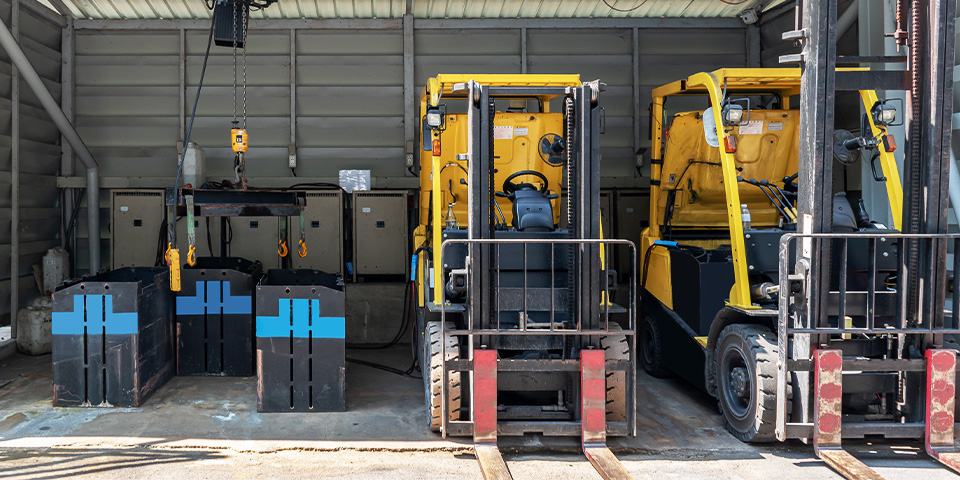
Material handling equipment, such as forklifts, relies on a range of power sources in order to operate. Older models tend to use propane, diesel or gasoline, but many newer models rely on electricity.
As a result, operators must understand new safety practices and regulations to protect themselves and those working around them.
Electric Forklift Terms to Know
Before you begin working with an electric forklift, you need to understand the following terms:
- Battery data plate: A forklift’s data plate contains information relevant to the forklift’s operation, such as its amp hours, input voltage and more. Typically, it can be found on the instrument panel. The data plate is also referred to as a capacity plate, nameplate or weight plate.
- Amp hours: This refers to the amount of current a battery can generate in a single hour. The charger’s amp-hour rating should be within 10% of the forklift battery’s amp-hour rating to avoid overcharging or undercharging the battery.
- Output voltage: Output voltage refers to the amount of energy a given device can send out. If the input voltage of the battery is higher than the output voltage of the charger, energy will not be able to flow into the battery. Assessing the charger’s output voltage relative to the battery’s input voltage is important.
- Input voltage: Input voltage refers to the amount of energy a given device can take in. If the output voltage of your facility’s power source is lower than the input voltage of the charger, energy will not flow in the proper direction. Working with an electrician to assess your facility’s voltage is crucial.
- Single-phase power: This term describes one variation of power load distribution. Single-phase power systems distribute power through a two-wire alternating current (AC) power circuit. Most warehouses do not use single-phase power, so be sure to assess both your facility’s power load distribution and that of the charger you intend to use to ensure they align.
- Three-phase power: This term describes the most prominent variation of power load distribution. Three-phase power systems distribute power through a three-wire AC power circuit, which creates a more even, steady flow of energy. These systems are very common, but you should still assess your facility’s power load distribution to ensure it matches your chargers rather than assuming you already have a three-phase power system.
- Discharge: The amount of energy a forklift can hold varies from model to model. Discharge refers to these rates of energy depletion. Knowing your forklift’s depletion rate allows you to keep it charged and operating properly.
- Sulfation: During discharge, sulfuric acid in the battery can attach to the battery plates and spill over onto the casing. Sulfation often occurs when the battery has not been fully charged recently or has stayed discharged for too long. If too much sulfuric acid builds up on the battery, its performance will be hampered, and it may reduce its lifespan.
OSHA and Electric Forklift Charging Safety
Interacting with your warehouse’s charging stations safely requires both an intimate understanding of the terms above and strict adherence to Occupational Safety and Health Administration (OSHA) guidelines.
These guidelines are extensive, and it’s essential for any team members interacting with the charging station to be properly trained and certified to align with OSHA Standard 1917. Regulations cover everything from where the charging stations are placed to how the charging is documented.

Forklift battery charging station safety requirements state that charging stations should be placed within designated areas with proper ventilation and air circulation to disperse dangerous hydrogen fumes. Fire protection and spill neutralization should be nearby, as should personal protective equipment (PPE). These items are vital for mitigating the consequences of accidents involving hydrogen fumes and battery acid. Installing acid-resistant floors, first-aid kits, spill kits and eyewash stations nearby will also mitigate the damage caused by spills, both for the facility and personnel.
Forklift charging safety naturally extends to personnel as well. Only team members with the proper training and certification should interact with charging stations and change batteries, and they should always wear PPE when doing so. They must also maintain safety data sheets (SDSs), inspection logs and incident reports to track all information related to the forklifts and their charging stations. This documentation provides insight into maintenance needs, safety practices and the health of individual forklifts.
How to Practice Safe Forklift Battery Charging
Charging an electric forklift is a relatively simple matter once you’re acquainted with the process. That said, there are a number of safety precautions involved that you will need to master. Here is how to charge an electric forklift:
- Park the forklift near the charging station.
- Set the parking brake and turn off the lift.
- Put on PPE, including gloves, an apron and a face shield.
- Raise the hood of the lift so that heat and fumes can disperse.
- Ensure metallic objects are clear of the charging area.
- Check the electrolyte levels.
- Check the battery ventilation holes/plugs to ensure hydrogen gas can escape safely.
- Turn the charger off before connecting it to the battery.
- Check that the charger and battery are compatible, in terms of both amp hours and voltage.
- Ensure that the charger connectors and cables are not damaged. If they are, invest in replacements or repair them.
- Disconnect the battery connector from the truck connector and connect it to the charger connector.
- Wait for the charger to turn on and — ideally — allow the forklift to reach 100% charge.
- Allow the charger to turn off automatically once the lift reaches 100% or turn it off manually.
- Disconnect the battery connector from the charger connector and reconnect it to the truck connector.
- Add distilled water to the battery if electrolyte levels were determined to be too high in Step 5.
Common Hazards of Forklift Charging
Failing to take forklift charging safety seriously can expose your facility, yourself and the people around you to serious hazards. These can include:
- Hydrogen gas fires and explosions.
- Battery acid burns to both facilities and personnel.
- Electric shocks.
- Blunt force injuries.
Should any of these incidents occur, your facility should have an emergency action plan in place to address the issue and keep everyone safe.
Partner With Burns Industrial Equipment for All Your Equipment Needs
If you’re looking to expand your forklift fleet or upgrade to the newest electric models, Burns Industrial Equipment has your back. We offer a wide range of newer forklift models, including forklifts from Hyster-Yale and Bendi.
Our inventory also includes used models and rental options, so you can find exactly what your warehouse needs at the price point you want.
To learn more about us, fill out our contact form.