
Warehouses today are under real pressure. Volumes are increasing, labor is tight and many facilities are working with layouts and equipment decisions made years ago. When internal transport systems aren’t well-matched to the operation, material movement becomes more complicated to manage, workflows feel disconnected and growth plans stall.
Learn the different types of internal warehouse transport systems so you can choose the right mix based on layout, throughput and long-term goals.
What Is Internal Warehouse Transport?
Internal warehouse transport refers to the movement of materials within a facility. This includes pallet movement, carton flow and item-level transport within defined warehouse zones.
These systems form the backbone of daily operations. When movement paths are clear and predictable, teams spend less time reacting to congestion and more time maintaining accuracy and throughput.
Why Efficient Internal Warehouse Transport Equipment Matters
The way materials move inside the warehouse directly affects labor usage, space and order fulfillment speed. Poorly aligned transport systems may increase travel distance and unnecessary handling steps and limit how effectively storage space can be used.
Internal transport also impacts the overall supply chain. For example, delays or congestion inside the warehouse can lead to missed shipping cutoffs or slower customer deliveries. Improving warehouse transport equipment and material flow is one of the most effective ways to support consistent supply chain performance.
Manual Transport Systems for Warehouse Material Flow Optimization
Manual transport systems remain essential, even in facilities that use conveyors or automation. They provide flexibility in areas where volumes are lower, distances are short or layouts change frequently.
Manual and Electric Pallet Trucks
Pallet trucks are one of the most common forms of warehouse transport equipment, particularly at ground level. They include the following vehicles:
- Manual pallet trucks: These are used for short-distance pallet movement in receiving, staging and dock areas where simplicity and reliability are essential.
- Electric pallet trucks: These reduce physical strain on operators when pallets must travel longer distances or when operators move pallets repeatedly throughout a shift.
- Dock and staging support: A consistent pallet truck fleet helps maintain steady inbound and outbound flow during peak loading and unloading periods.
Internal Carts and Trolleys
Carts and trolleys support tasks where pallets aren’t the primary load unit. They are useful for:
- Batch order picking: Operators can collect multiple small items in a single pass, reducing unnecessary travel.
- Maintenance and kitting movement: Carts and trolleys support the transport of tools, parts and supplies without tying up powered equipment.
- Low ownership burden: Simple construction and minimal maintenance make carts practical across many warehouse zones.
Powered Industrial Trucks for Vertical Storage and Heavy Loads
Powered industrial vehicles support stacking, retrieval and transport across multiple warehouse zones, making them essential for facilities that rely on racking systems and high-volume pallet movement.
Counterbalance Forklifts
Counterbalance forklifts handle a wide range of tasks without requiring specialized layouts. They are commonly used in receiving, storage and shipping areas where pallets move frequently between dock doors and racking.
Their straightforward design allows operators to load, lift and transport pallets with minimal complexity, making them a dependable option for many general material handling needs.
Reach Trucks and Very Narrow Aisle Equipment
Reach trucks and very narrow aisle equipment are designed for warehouses that need to store more product without expanding their footprint. By operating in tighter aisles and lifting loads higher, these trucks help facilities maximize available cubic space.
Operational factors to evaluate before investing in this equipment include:
- Aisle width reduction: Narrower aisles allow for additional racking and higher storage density.
- Vertical reach capability: Higher lift heights support multiple-level storage strategies.
- Operational structure requirements: Operator training, guidance systems and defined travel paths are typically necessary.
Order Pickers and Stock Pickers
Order pickers and stock pickers are designed for operations where individual items are picked directly from shelving or racking, rather than full pallets being moved. With these trucks, the operator travels upward with the load, allowing direct access to the product at height.
Side-Loaders
Instead of carrying loads in front of the truck, side-loaders transport materials lengthwise along the chassis. This design allows movement through narrower aisles without requiring wide running radii, making side-loaders a great solution for specialized storage environments.
They are commonly used in scenarios where load length exceeds standard pallet dimensions, space is limited or material stability is critical.
Conveyor Systems
Conveyor systems are best suited for warehouse areas where product moves along the same path repeatedly throughout the day. Unlike trucks and carts, conveyors create a fixed flow, making them ideal for high-volume zones where speed, consistency and predictability matter more than flexibility.

Belt and Roller Conveyors
Belt conveyors provide continuous surface support, making them well-suited for lightweight, irregularly shaped items or items moving along inclines. Roller conveyors, on the other hand, are typically used for cartons, totes and pallets that can move reliably across rollers.
These conveyor types are commonly selected when:
- Product shape varies: Belt conveyors support packages that may shift or tip on rollers.
- Accumulation is required: Roller conveyors allow products to queue without contact.
- Zones need to be connected: Conveyors link picking, packing and shipping into a single, steady flow.
Chain Conveyors
Chain conveyors are designed for applications where pallet weight or load conditions exceed what roller systems can reliably handle. They are often installed in pallet staging, transfer and load-building areas where durability and control are critical.
Since the chains engage pallets directly, these systems provide consistent movement even under demanding conditions. They are typically used in environments with uniform pallet loads and clearly defined travel paths.
Overhead Conveyors
Overhead conveyors shift product movement above the warehouse floor. By moving items overhead, these systems help reduce congestion in work areas and separate material flow from pedestrian traffic.
They are most often used in industry-specific applications, such as garment handling, finishing processes or paint lines, where products need to move through defined steps without interruption.
Automated Warehouse Transport
Automated transport systems are typically introduced where travel paths are repetitive, volumes are consistent and reducing manual travel time can improve overall flow. These systems are not meant to replace every form of material handling. Instead, they work best when paired with forklifts, pallet trucks and conveyors as part of a broader internal transport strategy.
Automated Guided Vehicles (AGVs)
AGVs are designed to follow predefined paths within the warehouse. These paths may be guided by embedded wires, magnetic tape or virtual mapping, depending on the application. These vehicles are often used to move pallets or materials between fixed points, such as from production to staging or from storage to shipping, on a repeating schedule.
AGVs are commonly selected when:
- Transport routes are consistent: Materials move along the same paths with little variation.
- Tasks are repetitive: Pallet transfers or milk runs occur at predictable intervals.
- Layouts remain stable: Facility configurations don’t change frequently.
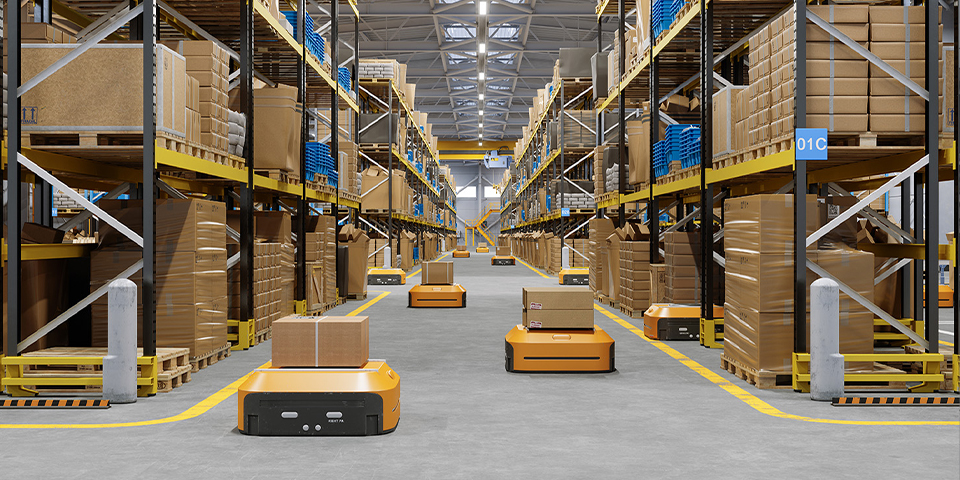
Autonomous Mobile Robots (AMRs)
AMRs offer a more flexible approach to automated warehouse transport. Instead of following fixed paths, AMRs navigate dynamically using sensors, mapping and onboard intelligence.
This flexibility allows them to adjust routes in real time, making them better suited for warehouses with changing layouts or mixed traffic patterns.
How to Choose the Right System for Your Warehouse
The right setup depends on how space, volume and workflows come together inside your facility. Key considerations when selecting internal warehouse transport systems include:
- Warehouse size and layout: Aisle width, ceiling height and racking configuration determine whether manual equipment, counterbalance forklifts, reach trucks or automated systems can operate safely and effectively.
- Throughput patterns and consistency: Lower or variable volumes often benefit from flexible manual or powered equipment, while high and consistent volumes support conveyors and automated warehouse transport.
- Scalability requirements: Transport systems should support future growth without requiring major redesigns or equipment replacement.
- Budget and long-term return: Initial equipment costs should be weighed alongside labor, maintenance, energy use and productivity over the full life cycle.
- Integration with existing systems: Internal transport must align with warehouse management systems to support visibility, coordination and predictable material flow.
Partner With a Systems Integrator
When transport systems are aligned with layout, volume and growth plans, warehouses gain clearer workflows, better use of space and more predictable daily operations.
Burns Industrial Equipment offers premium warehouse transport solutions, from manual trucks and forklifts to conveyors and automation. Contact us today so we can help you evaluate your current setup and identify systems that support reliable material flow and long-term operational goals.