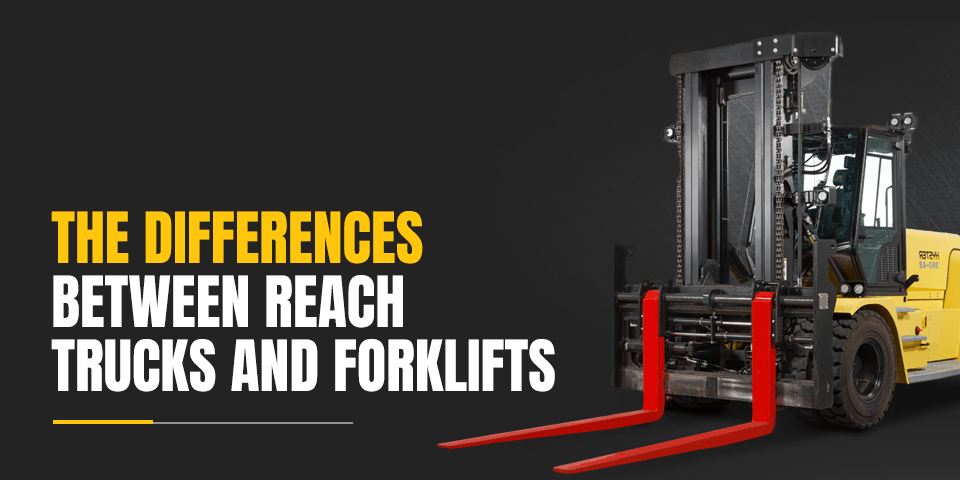
Reach trucks and forklifts are ideal for moving and lifting materials in a warehouse setting. This reach truck vs forklift guide breaks down how the two compare on reach, capacity, visibility and cost. Forklifts are suitable for lifting and transporting heavier loads, while reach trucks are best when you need to load or unload lighter, high-racking items. It’s essential to know the difference between a reach truck and a forklift before investing so you can get the right asset for your application.
What Are Reach Trucks and Forklifts?
While some of their functions can overlap, reach trucks and forklifts have distinct features that make them more efficient for specific tasks.
Forklift Overview
When most people refer to forklifts, they are talking about counterbalance forklifts. These machines typically consist of forks in the front, a counterbalance in the rear, a cab that houses the operator and tires that help control the steering. They have a counterweight at the back to balance the load. Counterbalance forklifts are among the most well-known and versatile material handling equipment types.
A forklift’s primary functions are lifting, moving and stacking pallets or contained units. While various models have different load capacities, most devices can comfortably handle up to 10,000 pounds.
Some of the different types of forklifts include:
- Pallet stackers for efficiently moving, stacking and retrieving loads
- Order pickers for accurate order fulfillment
- Special use case forklifts
Reach Truck Overview
Reach trucks are a type of forklift that provides enhanced mobility and maneuverability. They usually have slimmer and smaller bodies than counterbalance forklifts, making them ideal for facilities with narrow aisles. Instead of using a counterweight, reach trucks have two stabilizing outer legs that distribute load weight.
Reach trucks can usually accommodate a smaller load capacity than most counterbalance forklifts. However, they typically offer much higher height capacities when lifting.
Reach trucks come in a variety of types, such as:
- Moving mast reach trucks for higher reach
- Single-reach trucks that reach single pallet positions
- Double-reach trucks for retrieving loads located deeper in the racks
Reach Truck vs. Forklift: A Breakdown
This breakdown clearly summarizes the difference between a forklift and a reach truck so you can compare them side by side.
| Counterbalance Forklift | Reach Truck | |
| How loads are balanced | Counterweight | Base legs |
| Maneuverability | Needs wider aisles to turn | Turns in tight spaces |
| Fork extension | No | Yes |
| Driver position | Forward | Sideways |
| Visibility | Good | Excellent |
| Application versatility | Indoor and outdoor | Limited to indoor |
| Lift height | 20 feet on average | 40 feet or higher |
| Lift capacity | Over 25,000 pounds | Up to 5,000 pounds |
| Attachments | Supports many options | Limited to sideshifters |
| Power sources | Multiple | Electric |
| Controls | Steering wheel, gear, brake and accelerator | Steering wheel, joystick and deadman pedal |
More on the Differences Between Reach Trucks and Forklifts
If you’re wondering why counterbalance forklifts have average visibility and which applications are suitable for a reach truck, keep reading to learn more.
Visibility and Operator Position
Traditionally, forklift operators sit down when lifting loads. They face forward, which can sometimes minimize their visibility of the load. While most models require sitting, some forklifts allow operators to stand.
Reach trucks are the opposite, with more models supporting standing positions than sitting ones. The operator stands or sits sideways or perpendicular to the forks, giving them a good view of the load.
Turn Radius
Reach trucks maneuver in tight spaces better than counterbalance forklifts because they have a small turn radius. They can operate in aisles as tight as 8 feet wide. Forklifts need wider aisles for maneuvering due to their longer wheelbase and counterweight, which increases their length. They require aisle space of about 10 feet to 12 feet to maneuver.
Fork Extension
A typical forklift’s forks only move up and down, while a reach truck’s can move up, down, forward and backward. This extension ability is due to the pantograph mechanism, which permits reach trucks to extend forward to reach deeper into the racks to retrieve loads. The operator can then retract the pantograph, moving the load backward.
Lifting Height
On average, most forklifts can lift to 20 feet, while some reach trucks have lift capacities exceeding 40 feet. The additional height makes reach trucks suitable for warehouses with high racks.
Lifting Capacity
Most reach trucks have lift capacities ranging from 3,000 pounds to 5,000 pounds, while many forklifts can comfortably transport loads double that size. Some heavy-duty counterbalance forklift models can handle loads weighing over 25,000 pounds.
Attachments
Counterbalance forklifts support a wide variety of attachments to facilitate different use cases, while reach trucks are limited to forks on a sideshifter. Examples of forklift attachments include:
- Rotators
- Clamps
- Sweepers
- Plows
- Hooks
Power Sources
Many reach truck models typically operate on a 24-volt or 36-volt battery, while forklifts can use various power sources, like gasoline, liquefied petroleum gas (LPG), diesel or an electric battery.
Operating Environment
Forklifts operate indoors and outdoors, while reach trucks are ideal for indoor use on level and smooth surfaces. You’ll find reach trucks in warehouses, food distribution centers and manufacturing facilities. Forklifts are more versatile in their application and are often used in construction, warehouses, shipyards, lumberyards and manufacturing plants.
Forklifts use cushion tires for indoor operations and solid pneumatic or pneumatic tires for outdoor use. In contrast, warehouse reach trucks use polyurethane or cushion tires, which are suitable for indoor environments.
Controls
Similar to cars, forklifts have a steering wheel, accelerator and brake pedals, and a gear selector. Reach trucks also have a steering wheel, but the similarities with a forklift end there. To move forward or reverse and execute hydraulic functions, a reach truck operator uses a joystick.
Reach trucks also have a deadman pedal that the operator steps on when operating. If they lift off their foot, the reach truck automatically stops. This pedal offers safety, ensuring the equipment remains stationary when operators are away.
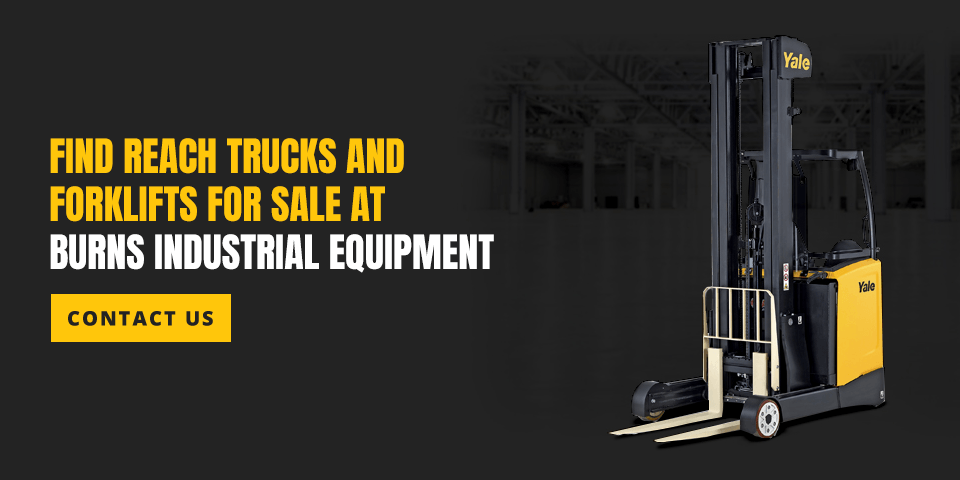
Find Reach Trucks and Forklifts for Sale at Burns Industrial Equipment
Whether you’re considering buying a forklift or reach truck, Burns Industrial Equipment offers an extensive selection of new and used models. We also offer flexible rental plans to meet your short-term needs. Contact us online, call 330-468-4900 or visit one of our convenient locations in Western Pennsylvania, Northeast Ohio or West Virginia today to learn more about reach trucks and forklifts.